
randomfacts.com.au
The Stephen CHILDS story begins with his mother Ellen HOUGHTON.
Elanor (Ellen) HOUGHTON
Ellen was the 4th child of William HOUGHTON and Charlotte WARE.
She was christened 20th April 1817 at Southwick (West Sussex, England).
She died 13th December 1850 (33yrs) and was buried at Southampton, England.
Ellen would have been about 10 years of age when her father (William HOUGHTON) died in 1827. Charlotte (her mother) had 5 children between the ages of 5 and 17 yrs. In 1833, Ellen was living in Soberton, a small village in the Meon Valley, Hampshire. Soberton was, following the French Napoleonic Wars (1803 to 1815), an extremely poor village with many living in poverty. Ellen was listed as a pauper and around 16 years old when she gave birth to Stephen HOUGHTON on 5th September 1833 at Soberton. There was no father listed on the birth register. Stephen HOUGHTON was baptised in 1834 at Soberton. Around 1839, Ellen gave birth to her second son, George HOUGHTON. Again, no father was listed on the birth register.
In the 1841 England, Wales & Scotland Census, Ellen HOUGHTON was living at Soberton in the household of William RICKS (REEKS) with her two children Stephen (6yrs) and George HOUGHTON (2yrs). Ellen HOUGHTON married William GARDINER 1st September 1849. On the marriage record, her father was William HOUGHTON. Also mentioned on this marriage record was William REEKS (RICKS) and Eliza MATTHEWS (Eliza was her sister). Her son William GARDINER was born late in 1850. Ellen GARDNER died on 13 December 1850 (33yrs old) and was buried at Southampton. William was christened 25 Dec 1850 at Soberton. It looks very like Ellen may have died from complications with the birth. Stephen HOUGHTON was 17yrs old and his brother George was 11 years old. In the 1851 Census, Stephen HOUGHTON and George HOUGHTON (his brother) were still living in the household of William REEKS at Soberton. In the 1861 Census, George HOUGHTON was again living in the household of William REEKS.
Soberton is a small village about 25km east of Southampton on the south coast of England. The church of St. Peters was originally built in the 12th century, the White Lion Hotel was built in the 17th century, and the village was part of a major smuggling route in the 18th Century. A vault beneath the church was even used for storing contraband.
Elanor (Ellen) HOUGHTON
Ellen was the 4th child of William HOUGHTON and Charlotte WARE.
She was christened 20th April 1817 at Southwick (West Sussex, England).
She died 13th December 1850 (33yrs) and was buried at Southampton, England.
Ellen would have been about 10 years of age when her father (William HOUGHTON) died in 1827. Charlotte (her mother) had 5 children between the ages of 5 and 17 yrs. In 1833, Ellen was living in Soberton, a small village in the Meon Valley, Hampshire. Soberton was, following the French Napoleonic Wars (1803 to 1815), an extremely poor village with many living in poverty. Ellen was listed as a pauper and around 16 years old when she gave birth to Stephen HOUGHTON on 5th September 1833 at Soberton. There was no father listed on the birth register. Stephen HOUGHTON was baptised in 1834 at Soberton. Around 1839, Ellen gave birth to her second son, George HOUGHTON. Again, no father was listed on the birth register.
In the 1841 England, Wales & Scotland Census, Ellen HOUGHTON was living at Soberton in the household of William RICKS (REEKS) with her two children Stephen (6yrs) and George HOUGHTON (2yrs). Ellen HOUGHTON married William GARDINER 1st September 1849. On the marriage record, her father was William HOUGHTON. Also mentioned on this marriage record was William REEKS (RICKS) and Eliza MATTHEWS (Eliza was her sister). Her son William GARDINER was born late in 1850. Ellen GARDNER died on 13 December 1850 (33yrs old) and was buried at Southampton. William was christened 25 Dec 1850 at Soberton. It looks very like Ellen may have died from complications with the birth. Stephen HOUGHTON was 17yrs old and his brother George was 11 years old. In the 1851 Census, Stephen HOUGHTON and George HOUGHTON (his brother) were still living in the household of William REEKS at Soberton. In the 1861 Census, George HOUGHTON was again living in the household of William REEKS.
Soberton is a small village about 25km east of Southampton on the south coast of England. The church of St. Peters was originally built in the 12th century, the White Lion Hotel was built in the 17th century, and the village was part of a major smuggling route in the 18th Century. A vault beneath the church was even used for storing contraband.
Children of Ellen HOUGHTON
1. Stephen HOUGHTON b. 5th September 1833 at Soberton, England, d. 20th October 1906 at Littlehampton.
2. George HOUGHTON b.1839 at Soberton, England.
3. William GARDINER b.1850 Droxford, Hampshire, England.
1. Stephen HOUGHTON b. 5th September 1833 at Soberton, England, d. 20th October 1906 at Littlehampton.
2. George HOUGHTON b.1839 at Soberton, England.
3. William GARDINER b.1850 Droxford, Hampshire, England.
Stephen HOUGHTON
Stephen was the 1st child of Ellen HOUGHTON (no father listed).
He was born 5th September 1833 at Soberton, Hampshire, England.
In the the 1841 England, Wales & Scotland Census, Stephen was 6 years old, and living with his mother and younger brother (George) on a farm at Soberton owned by William RICKS (REEKS). His mother was the housekeeper, and there was one source that said that Stephen's grandfather (William HOUGHTON) had an interest in the farm with William RICKS. In 1849, Stephen's mother (Ellen HOUGHTON) married William GARDINER and died just over a year later following the birth of her son William GARDINER (jnr). In the the 1851 England, Wales & Scotland Census, Stephen was 18 years old and still living on the farm owned by William RICKS (REEKS) along with his younger brother George.
Stephen was the 1st child of Ellen HOUGHTON (no father listed).
He was born 5th September 1833 at Soberton, Hampshire, England.
In the the 1841 England, Wales & Scotland Census, Stephen was 6 years old, and living with his mother and younger brother (George) on a farm at Soberton owned by William RICKS (REEKS). His mother was the housekeeper, and there was one source that said that Stephen's grandfather (William HOUGHTON) had an interest in the farm with William RICKS. In 1849, Stephen's mother (Ellen HOUGHTON) married William GARDINER and died just over a year later following the birth of her son William GARDINER (jnr). In the the 1851 England, Wales & Scotland Census, Stephen was 18 years old and still living on the farm owned by William RICKS (REEKS) along with his younger brother George.
Stephen HOUGHTON was a passenger on the 'HENRY MOORE' which departed from Plymouth, England 24th June 1857. The ship log listed Stephen as 27 years old, a farm labourer, from Hampshire but it is more likely that he was 24yrs old. 'HENRY MOORE' was the 10th ship from England to South Australia in 1857, and the largest, carrying 382 passengers (some sources say 292 passengers). There were 11 births and 5 deaths on the voyage. Of the 5 deaths, 3 were infants. The ship arrived at Port Adelaide on 13 September 1857. Stephen lived at Bowden for about a year before moving to the Mount Barker area.
It is interesting to note that there was another family from Soberton emigrating on the 'HENRY MOORE' at the same time. Edward LACEY, his wife and four children, the eldest being Richard LACEY (23yrs old). Given that Soberton was a small village, it seems likely that Richard and Stephen were known to one another and perhaps Stephen decided to join them on their emigration to South Australia.
It is interesting to note that there was another family from Soberton emigrating on the 'HENRY MOORE' at the same time. Edward LACEY, his wife and four children, the eldest being Richard LACEY (23yrs old). Given that Soberton was a small village, it seems likely that Richard and Stephen were known to one another and perhaps Stephen decided to join them on their emigration to South Australia.
Ann COPPIN
Ann COPPIN was actually Ann DENCE.
She was born on 15th March 1835 at Sellindge, Kent, England
Her mother was Charlotte DENCE (no father listed)
In 1837, Ann's (Charlotte) mother married James COPPIN.
The COPPIN family emigrated to South Australia on 'GOMELZA', departing Southampton 2nd March 1856. They arrived at Port Adelaide, South Australia 10 June 1856. Ann DENCE was listed on the ship log as a single female. The COPPIN family moved directly to Littlehampton where James COPPIN established a brickyard.
Click Here for more information about the COPPIN family
Click Here for more information about the COPPIN brickyard.
Ann COPPIN was actually Ann DENCE.
She was born on 15th March 1835 at Sellindge, Kent, England
Her mother was Charlotte DENCE (no father listed)
In 1837, Ann's (Charlotte) mother married James COPPIN.
The COPPIN family emigrated to South Australia on 'GOMELZA', departing Southampton 2nd March 1856. They arrived at Port Adelaide, South Australia 10 June 1856. Ann DENCE was listed on the ship log as a single female. The COPPIN family moved directly to Littlehampton where James COPPIN established a brickyard.
Click Here for more information about the COPPIN family
Click Here for more information about the COPPIN brickyard.
Stephen HOUGHTON married Ann COPPIN at the Wesleyan Chapel, Mount Barker on 4 December 1858.
For each of the children of this marriage, he was listed as Stephen CHILDS or Stephen H. Childs. Stephen and Ann even named one of their sons Stephen Houghton CHILDS. Stephen and Ann lived most of their life at Littlehampton except for three years spent at Grunthal (now Verdun).
Click Here for more information about hills localities.
So, Stephen HOUGHTON became Stephen CHILDS after his marriage to Ann COPPIN (who was actually Ann DENCE). This was initially a bit of a puzzle, but Stephen's obit, published in the Adelaide Chronicle Sat 3rd November 1906 helped. "Mr. Stephen H. Childs. of Littlehampton near Mount Barker, died on October 20. He was born in Soberton, Hampshire on September 5, 1833, and landed in South Australia, in September, 1857" (the full obit is below). The only ship to arrive in South Australia in September 1857 was "HENRY MOORE' and Stephen HOUGHTON was on it. The birth date and location also matches.
The question remains, why did he change his name. A possible answer has come from a researcher I have been in contact with from Soberton, England. She told me that it was common for unmarried mothers to name their children after the father, and there was a CHILD family at Soberton at the time Ellen fell pregnant (at 16yrs old), and they had a son Stephen CHILD who was 20yrs at the time. She also said that it was common in the Hampshire area for a surname like CHILD to become CHILDS over time. Stephen CHILD died and was buried on 29th December 1837 (aged 25yrs). It would seem entirely plausible that Stephen CHILD was his father, and he took his father's name after arriving here in South Australia.
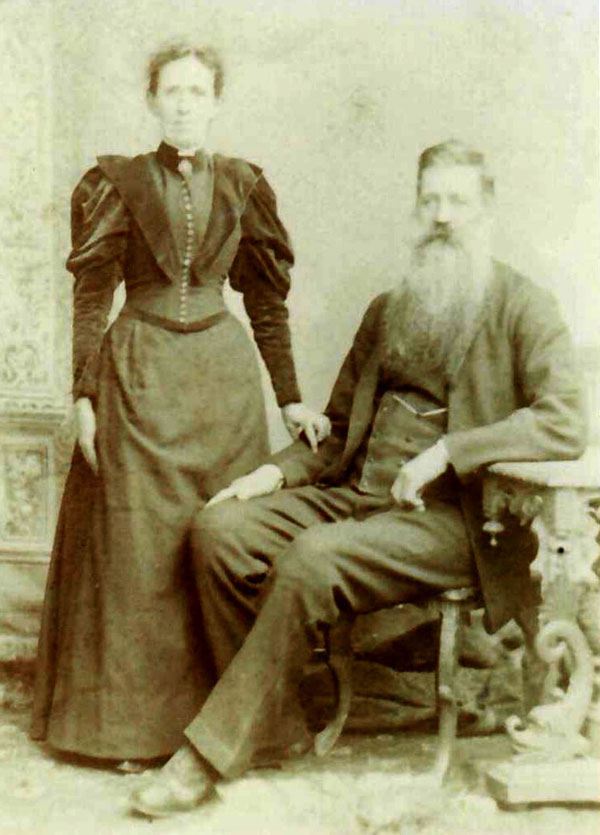
For each of the children of this marriage, he was listed as Stephen CHILDS or Stephen H. Childs. Stephen and Ann even named one of their sons Stephen Houghton CHILDS. Stephen and Ann lived most of their life at Littlehampton except for three years spent at Grunthal (now Verdun).
Click Here for more information about hills localities.
So, Stephen HOUGHTON became Stephen CHILDS after his marriage to Ann COPPIN (who was actually Ann DENCE). This was initially a bit of a puzzle, but Stephen's obit, published in the Adelaide Chronicle Sat 3rd November 1906 helped. "Mr. Stephen H. Childs. of Littlehampton near Mount Barker, died on October 20. He was born in Soberton, Hampshire on September 5, 1833, and landed in South Australia, in September, 1857" (the full obit is below). The only ship to arrive in South Australia in September 1857 was "HENRY MOORE' and Stephen HOUGHTON was on it. The birth date and location also matches.
The question remains, why did he change his name. A possible answer has come from a researcher I have been in contact with from Soberton, England. She told me that it was common for unmarried mothers to name their children after the father, and there was a CHILD family at Soberton at the time Ellen fell pregnant (at 16yrs old), and they had a son Stephen CHILD who was 20yrs at the time. She also said that it was common in the Hampshire area for a surname like CHILD to become CHILDS over time. Stephen CHILD died and was buried on 29th December 1837 (aged 25yrs). It would seem entirely plausible that Stephen CHILD was his father, and he took his father's name after arriving here in South Australia.
Stephen was described as a man of exceptionally fine physique (at 24 years of age he stood 6 ft. 3 in. high and weighed 16 stone.). We know that Stephen was working as a labourer in 1860, He helped form the main road to Nairne. At various times in his life he was a labourer, sawyer and in later years, a dairy farmer.
In 1863, Stephen travelled to New Zealand to try his luck in the Otago gold rush. He wrote an article in the South Australian Register which was published 3rd September 1863.
Having just returned from New Zealand, and being aware of your desire to place reliable information on all matters of public interest before your readers. I have been induced to record my experience of the gold diggings there, trusting that an account of the privations and dangers undergone by those who have been venturesome enough to proceed thither may deter others from following their example, and sharing their disappointment nnd suffering. I arrived at Dunedin in January last, and after remaining there two days set out for the Dunstan. The route thither is intersected with rivers, distant about four or five miles from each other, and averaging from two to three feet in depth, There are also huge mountains which it takes three or four hours to climb, and timber is so scarce that you may at times travel 40, 80, or 100 miles without seeing a stick - of wood thicker than the stalk of a tobacco-pipe. I have spent as much as three hours in boiling a two-quart billy with grass, the snow falling during the whole time. It is a frequent thing after travelling 14 or 15 miles to be obliged to creep under a rock for shelter, because the thickness of the snow upon the ground will not admit of the erection of a tent. On the 18th April last a billy of tea which I had placed in my tent was frozen quite hard, and it was not unusual to have to ford a frozen river while the weather was so cold as to freeze the water resting on one's hair into ice, and after crossing it to encounter a snowstorm lasting for four or five hours, and covering the ground to a depth of about 1* inches. In addition to this landslips are very common on the Shotover diggings; and I have known as many as 40 men having been overwhelmed by one of these. The hospitals at that and the other diggings are crowded with inmates suffering from scurvy and the effects of frost. Hundreds have been frostbitten, and it is no uncommon thing to see persons who have lost a limb, or their ears or nose, from this cause. On the Tomahawk diggings the price of flour is 18d. per lb., mutton 18d., beef 18d., sugar 18d., and other things in proportion. The digger's working there are making on an average three grains of gold per day, and hundreds employ themselves in gathering the Maori cabbage and in shooting cockawes to obtain a livelihood. Scores of men go over the mountains to fetch a kind of firewood called hardlines, or Irish scrub, which they sell at 5s. a bundle, and it has frequently cost me sixpence to buy wood sufficient to boil a billy with. At the last diggings to which I went, the Hogburn rush, I found about a foot of snow on the ground, and being without a stick of firewood i had to scrape away the snow and spread my blanket on the ground to pass the night upon. Hundreds are going to the diggings every day and hundreds returning, the average amount of gold obtained being about 1 dwt. a day for four men. The diggings are mostly situated near the beds of rivers, and whenever the sun shines a flood ensues, in consequence of the snow on the mountains being made to melt. There are hundreds of persons wandering about the streets of Duuedin without the means of getting employment or food, and numbers are volunteering to go and fight the Maories in order to procure something to eat. Trusting you wili insert these few unvarnished statements, I am, Sir, &c. STEPHEN CHILDS. Little Hampton, September 2.
In 1870, he went north to work on the Darwin to Roper River section of the Overland Telegraph Line project. The building of this line was considered to be the greatest engineering feat of 19th century Australia. It was completed in 1872 and subsequently connected to the Java to Darwin under-sea cable. Australia's communication time with Europe was reduced from months to hours.
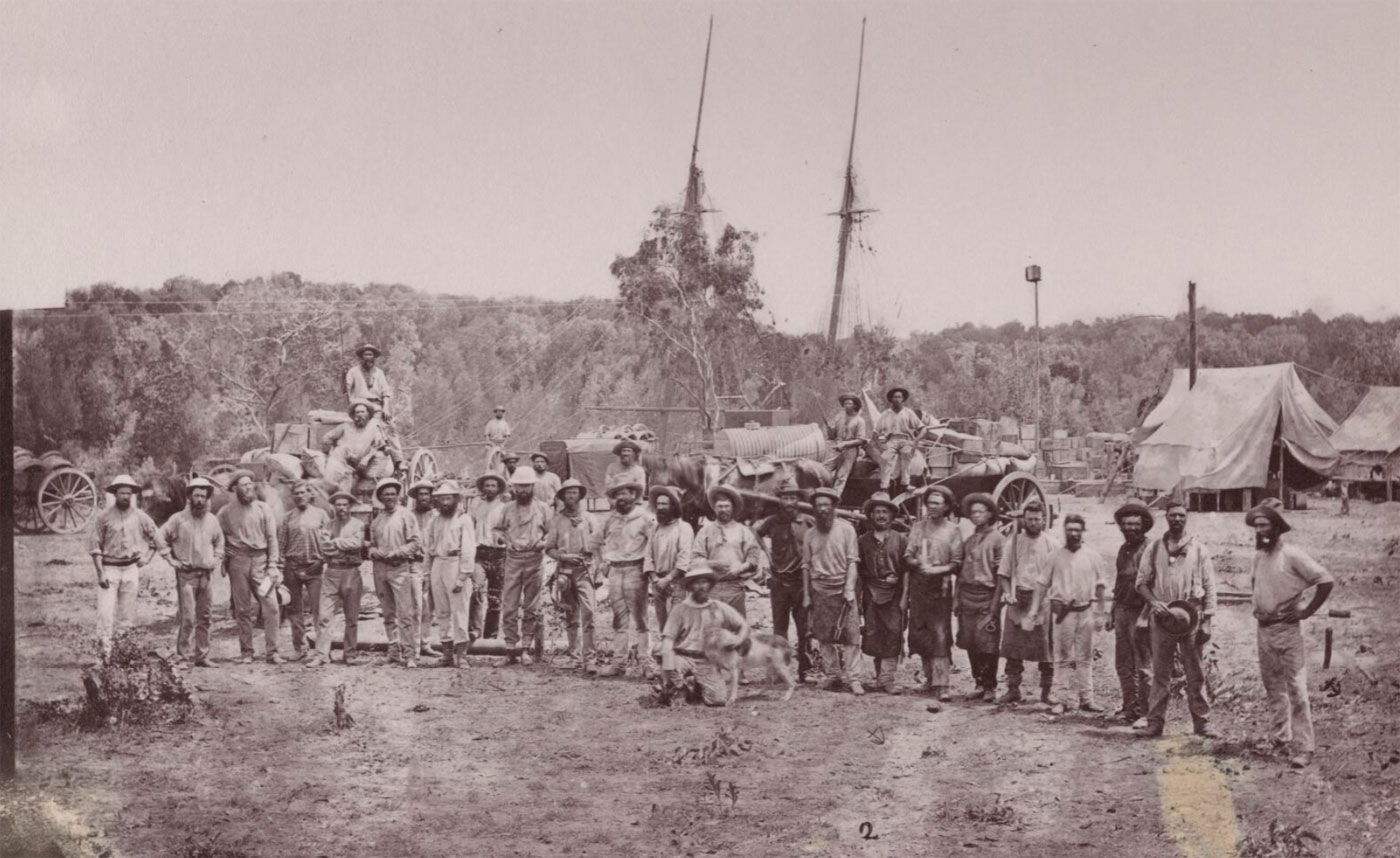
The Overland Telegraph gang. It is possible that Stephen CHILDS is the man standing on the cart on the left leaning against the bags.
In 1890, Stephen was a councillor with the Mount Barker Council.
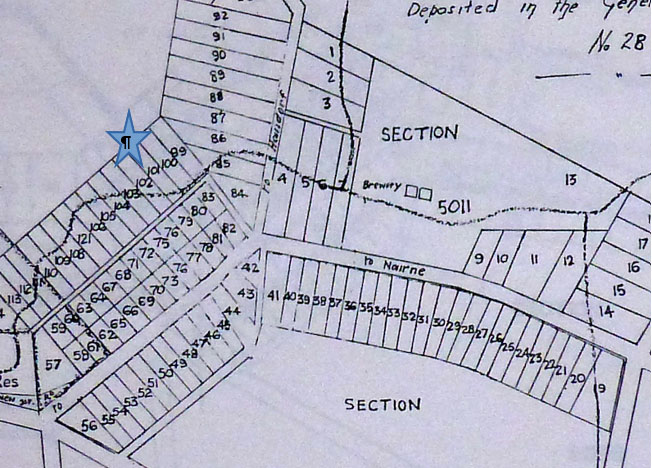
In 1891, Stephen CHILDS lived at allotments Nos. 99, 100, 101 in Littlehampton. As best as I can tell, this is on the western side of Clem's Lane about 80metres west from the junction of Clem's Lane and Cleggett Road.
In 1892, Stephen Childs reported Annie Elizabeth Daly for maliciously damaging wreaths and ribbons on the grave of Beatrice Childs in the Blakiston churchyard. The case went to trial but was dismissed. Stephen was for many years a member of the Loyal Britannia Lodge of Oddfellows, Mount Barker, and made a commanding and influential marshal on special occasions, such as pro-cessions in connection with the lodge picnics. He had much, experience with stock, and his services and advice were frequently sought in veterinary cases.
In his last year, he contracted bronchitis and subsequently was afflicted with dropsy (Dropsy was an old term for the swelling of soft tissues due to the accumulation of excess water. Today, the major or underlying causes of dropsy are said to be congestive heart failure, liver failure, kidney failure, and malnutrition).
In 1863, Stephen travelled to New Zealand to try his luck in the Otago gold rush. He wrote an article in the South Australian Register which was published 3rd September 1863.
Having just returned from New Zealand, and being aware of your desire to place reliable information on all matters of public interest before your readers. I have been induced to record my experience of the gold diggings there, trusting that an account of the privations and dangers undergone by those who have been venturesome enough to proceed thither may deter others from following their example, and sharing their disappointment nnd suffering. I arrived at Dunedin in January last, and after remaining there two days set out for the Dunstan. The route thither is intersected with rivers, distant about four or five miles from each other, and averaging from two to three feet in depth, There are also huge mountains which it takes three or four hours to climb, and timber is so scarce that you may at times travel 40, 80, or 100 miles without seeing a stick - of wood thicker than the stalk of a tobacco-pipe. I have spent as much as three hours in boiling a two-quart billy with grass, the snow falling during the whole time. It is a frequent thing after travelling 14 or 15 miles to be obliged to creep under a rock for shelter, because the thickness of the snow upon the ground will not admit of the erection of a tent. On the 18th April last a billy of tea which I had placed in my tent was frozen quite hard, and it was not unusual to have to ford a frozen river while the weather was so cold as to freeze the water resting on one's hair into ice, and after crossing it to encounter a snowstorm lasting for four or five hours, and covering the ground to a depth of about 1* inches. In addition to this landslips are very common on the Shotover diggings; and I have known as many as 40 men having been overwhelmed by one of these. The hospitals at that and the other diggings are crowded with inmates suffering from scurvy and the effects of frost. Hundreds have been frostbitten, and it is no uncommon thing to see persons who have lost a limb, or their ears or nose, from this cause. On the Tomahawk diggings the price of flour is 18d. per lb., mutton 18d., beef 18d., sugar 18d., and other things in proportion. The digger's working there are making on an average three grains of gold per day, and hundreds employ themselves in gathering the Maori cabbage and in shooting cockawes to obtain a livelihood. Scores of men go over the mountains to fetch a kind of firewood called hardlines, or Irish scrub, which they sell at 5s. a bundle, and it has frequently cost me sixpence to buy wood sufficient to boil a billy with. At the last diggings to which I went, the Hogburn rush, I found about a foot of snow on the ground, and being without a stick of firewood i had to scrape away the snow and spread my blanket on the ground to pass the night upon. Hundreds are going to the diggings every day and hundreds returning, the average amount of gold obtained being about 1 dwt. a day for four men. The diggings are mostly situated near the beds of rivers, and whenever the sun shines a flood ensues, in consequence of the snow on the mountains being made to melt. There are hundreds of persons wandering about the streets of Duuedin without the means of getting employment or food, and numbers are volunteering to go and fight the Maories in order to procure something to eat. Trusting you wili insert these few unvarnished statements, I am, Sir, &c. STEPHEN CHILDS. Little Hampton, September 2.
In 1870, he went north to work on the Darwin to Roper River section of the Overland Telegraph Line project. The building of this line was considered to be the greatest engineering feat of 19th century Australia. It was completed in 1872 and subsequently connected to the Java to Darwin under-sea cable. Australia's communication time with Europe was reduced from months to hours.
The Overland Telegraph gang. It is possible that Stephen CHILDS is the man standing on the cart on the left leaning against the bags.
In 1890, Stephen was a councillor with the Mount Barker Council.
In 1891, Stephen CHILDS lived at allotments Nos. 99, 100, 101 in Littlehampton. As best as I can tell, this is on the western side of Clem's Lane about 80metres west from the junction of Clem's Lane and Cleggett Road.
In 1892, Stephen Childs reported Annie Elizabeth Daly for maliciously damaging wreaths and ribbons on the grave of Beatrice Childs in the Blakiston churchyard. The case went to trial but was dismissed. Stephen was for many years a member of the Loyal Britannia Lodge of Oddfellows, Mount Barker, and made a commanding and influential marshal on special occasions, such as pro-cessions in connection with the lodge picnics. He had much, experience with stock, and his services and advice were frequently sought in veterinary cases.
In his last year, he contracted bronchitis and subsequently was afflicted with dropsy (Dropsy was an old term for the swelling of soft tissues due to the accumulation of excess water. Today, the major or underlying causes of dropsy are said to be congestive heart failure, liver failure, kidney failure, and malnutrition).
Stephen Houghton CHILDS died on 20 Oct 1906 (73yrs) at his residence at Little Hampton. He was buried at St James Anglican Church Cemetery, Blakiston. In a newspaper funeral notice at the time, Ann was referred to as Annie. Ann died 9th July 1922 (87yrs) at 161 Young Street, Parkside (a funeral notice said it was her residence). She was buried at St. James Church, Blakiston, with Stephen.
Stephen CHILDS Obit
Published in in the Adelaide Chronicle on Sat 3 Nov 1906
Mr. Stephen H. Childs. of Littlehampton near Mount Barker, died on October 20. He was born in Soberton, Hampshire on September 5, 1833, and landed in South Australia, in September, 1857. After residing at Bowden for a year or so he removed to the Mount Barker district and, save for three years spent at Grunthal, had made Littlehampton his home for half a century. He helped to form the main road to Nairne, and although subsequently he followed the occupation of a sawyer for a long time, latterly, he had been dairying. Like most pioneers, he had travelled a good deal, and in addition to being one of the party who laid the telegraph line from Port Darwin to the Roper River, he tried his luck at gold-digging at Snowy River, New Zealand, in 1851. He was a man of exceptionally fine physique (at 24 years of age he stood 6 ft. 3 in. high and weighed 16st.) and he enjoyed good health up till about six months ago, when, he contracted bronchitis, and lastly was afflicted with dropsy. Mr. Childs was for many years a member of the Loyal Britannia Lodge of Oddfellows, Mount Barker, and made a commanding and influential marshal on special occasions, such as processions in connection with the lodge picnics. He had much, experience with stock, and his services and advice were frequently sought in veterinary cases. He left a widow (a daughter of the late Mr. James Coppin, of Littlehampton), seven sons, and two daughters (Messrs. H.T. Childs, J.A. Childs, W.B. Childs. S.H. Childs, and Samuel Childs, Littlehampton; Mr. L. Childs, Petersburg; Mr. Hurtle Childs, Adelaide; and Mesdames John Glaffey, Glenelg, and W. F. Chapman, Nairne). There are 15 grandchildren.
Published in in the Adelaide Chronicle on Sat 3 Nov 1906
Mr. Stephen H. Childs. of Littlehampton near Mount Barker, died on October 20. He was born in Soberton, Hampshire on September 5, 1833, and landed in South Australia, in September, 1857. After residing at Bowden for a year or so he removed to the Mount Barker district and, save for three years spent at Grunthal, had made Littlehampton his home for half a century. He helped to form the main road to Nairne, and although subsequently he followed the occupation of a sawyer for a long time, latterly, he had been dairying. Like most pioneers, he had travelled a good deal, and in addition to being one of the party who laid the telegraph line from Port Darwin to the Roper River, he tried his luck at gold-digging at Snowy River, New Zealand, in 1851. He was a man of exceptionally fine physique (at 24 years of age he stood 6 ft. 3 in. high and weighed 16st.) and he enjoyed good health up till about six months ago, when, he contracted bronchitis, and lastly was afflicted with dropsy. Mr. Childs was for many years a member of the Loyal Britannia Lodge of Oddfellows, Mount Barker, and made a commanding and influential marshal on special occasions, such as processions in connection with the lodge picnics. He had much, experience with stock, and his services and advice were frequently sought in veterinary cases. He left a widow (a daughter of the late Mr. James Coppin, of Littlehampton), seven sons, and two daughters (Messrs. H.T. Childs, J.A. Childs, W.B. Childs. S.H. Childs, and Samuel Childs, Littlehampton; Mr. L. Childs, Petersburg; Mr. Hurtle Childs, Adelaide; and Mesdames John Glaffey, Glenelg, and W. F. Chapman, Nairne). There are 15 grandchildren.
Children of Stephen CHILDS & Ann COPPIN
1. Hugh Thomas CHILDS b. 29 Apr 1861, Little Hampton, m. Emma SLEADER
2. Beatrice Honor CHILDS b. 14 Dec 1862, Little Hampton
3. James Alfred CHILDS b. 12 Jul 1864, Little Hampton, m. Amy LEWIS
4. Willie Burton CHILDS b. 14 Apr 1866, Little Hampton, m. Jessie CRAIG
5. Stephen Houghton CHILDS b. 29 May 1868, Little Hampton, m.1 Harriett CLEGGETT, m.2 Hannah POWELL
6. Alice Lavinia CHILDS b. 12 Feb 1871, Little Hampton, m. John Joseph CLAFFEY
7. Louis Coppin CHILDS b. 18 Dec 1872, Grunthal (Verdun), m. Mary Jane DAVIDSON
8. Charlotte Ellen (Lottie) CHILDS b. 9 Jan 1875, Little Hampton, m. William Frederick CHAPMAN
9. Samuel (Sam) CHILDS b. 14 Dec 1876, Littlehampton, m. Daphne Young CORNELIUS
10. Eliza Jane CHILDS b. 7 Jul 1879, Little Hampton, d. 29th December 1881 (2yrs)
11. Hurtle George CHILDS b. 8 Jul 1882 at Little Hampton
1. Hugh Thomas CHILDS b. 29 Apr 1861, Little Hampton, m. Emma SLEADER
2. Beatrice Honor CHILDS b. 14 Dec 1862, Little Hampton
3. James Alfred CHILDS b. 12 Jul 1864, Little Hampton, m. Amy LEWIS
4. Willie Burton CHILDS b. 14 Apr 1866, Little Hampton, m. Jessie CRAIG
5. Stephen Houghton CHILDS b. 29 May 1868, Little Hampton, m.1 Harriett CLEGGETT, m.2 Hannah POWELL
6. Alice Lavinia CHILDS b. 12 Feb 1871, Little Hampton, m. John Joseph CLAFFEY
7. Louis Coppin CHILDS b. 18 Dec 1872, Grunthal (Verdun), m. Mary Jane DAVIDSON
8. Charlotte Ellen (Lottie) CHILDS b. 9 Jan 1875, Little Hampton, m. William Frederick CHAPMAN
9. Samuel (Sam) CHILDS b. 14 Dec 1876, Littlehampton, m. Daphne Young CORNELIUS
10. Eliza Jane CHILDS b. 7 Jul 1879, Little Hampton, d. 29th December 1881 (2yrs)
11. Hurtle George CHILDS b. 8 Jul 1882 at Little Hampton
Copyright randomfacts.com.au 2026
You may not reproduce or communicate any of the content on this website, including files downloadable from this website (unless otherwise indicated).
 enquiries@randomfacts.com.au
You may not reproduce or communicate any of the content on this website, including files downloadable from this website (unless otherwise indicated).
enquiries@randomfacts.com.au